Introduction
What is GPS-X?
GPS-X is a software tool that allows for the mathematical modeling, simulation, optimization, and management of wastewater treatment plants. It uses a simple drag and drop interface and comprehensive selection of unit processes to allow for users to simply develop a plant model, enter in characterization data, and run simulations.
Why Create Models of Wastewater Treatment Plants?
Models are most commonly implemented to “stand-in” for a real plant process, when testing and analysis on the actual plant is not available or feasible. The five primary reasons are as follows:
1. Allow for the comparison of various designs, process retrofits or operating strategies
Here users can simply adjust a plant design through the adjustment and/or addition of unit processes. For instance, modelling could be used to determine the sizing of the anoxic, and aerobic zones in an IFAS bioreactor to achieve a particular level of effluent quality.
2. Verify the capacity of the existing plant
For a plant experiencing higher influent flows due to surrounding population growth, a model of the plant could be run at increasing flow rates to determine the flow rate at which the plants effluent quality or design capacity would be theoretically exceeded.
3. Determine process bottlenecks
A plant model could allow for identification of which operational units are causing overall plant performance. For instance, it could help identify if the secondary clarifier wastage rate was too low, resulting in sludge buildup in the clarifier and higher TSS concentrations in the effluent.
4. Identify strategies to allow for enhanced cost savings
Many plants are operated in a conservative manner to limit the potential for poor effluent quality. While it is extremely important to maintain good treatment of wastewater, some practises can lead to an excessive use of energy. For example, through the use of modelling, it could be determined that a plant could be operated at a DO setpoint of 1.4 mg/L rather than 2 mg/L allowing for huge energy savings and negligible change in the effluent water quality.
5. Support regulatory decision making
Wastewater treatment plants are responsible for reporting to regulatory bodies. In cases where an effluent limit was exceeded they may need to provide a reasonable explanation for the cause of the exceedance. For instance, using a simulation model could help determine that consistently low winter temperatures were responsible for TAN breakthrough in the effluent.
Objectives
Before moving forward with the tutorials, take a moment to familiarize yourself with the GPS-X interface. This introduction will provide a basic tour of the interface, allowing new users to become more comfortable with the layout, prior to building and running plant model simulations.
Modelling environment
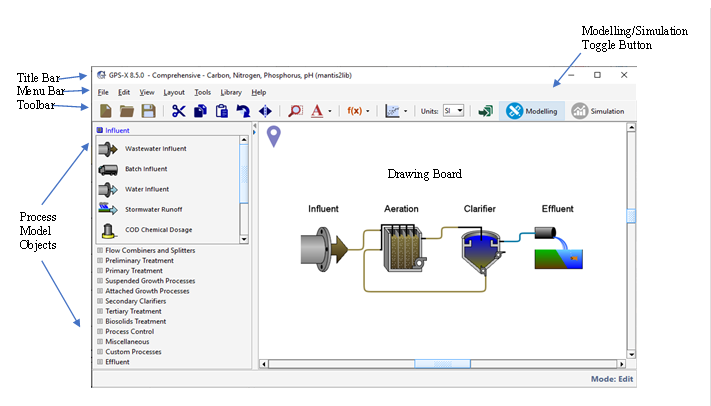
Once GPS-X is opened, observe the basic elements of the GPS-X interface. Make note that you are in Modelling Mode and the button at the top-right of the window can be used to switch between Modelling Mode and Simulation Mode.
Title Bar
Located here is information regarding the version of GPS-X being used, the name of the model layout being edited, and the library that the layout is using.
Menu Bar
Here there are several menus available:
1. File: Contains items for file handling and manipulation. Additionally, users can access sample layouts, including those for the tutorials, create a zip folder of all files associated with the model layout, and view historical model layouts.
2. Edit: allows users to manipulate objects on the drawing board such as cutting and pasting an object or rotating it.
3. View: allows users to adjust the look of the drawing board and how model objects are being displayed.
4. Layout: allows the user to specify global simulation properties, customized user-code and common plant-wide properties.
5. Tools: allows access to items relating to the setup and use of a plant model.
6. Library: provides access to a list of available libraries in GPS-X. Please access the Technical Reference Manual for more information.
7. Help: Under Help>Manuals, users can reference 5 documents relating to GPS-X. These should be referred to first when troubleshooting or learning how to use the software. By selecting
Tool Bar
The buttons in this section allow for quick access to particular functions in GPS-X. All of these functions are found in the menus presented in the menu bar.
Process Model Objects
These are the available model objects that can be used to construct the plant models. These are divided into subsections based on their function. For example, under the Suspended Growth Processes header, users can locate objects for a CSTR, plug-flow tank, and a membrane bioreactor.
Drawing Board
This large white space is where the model objects are arranged to construct a plant model.
Using the button at the top-right of the screen you can switch into Simulation Mode. Observe the basic elements of the interface.
Simulation Environment
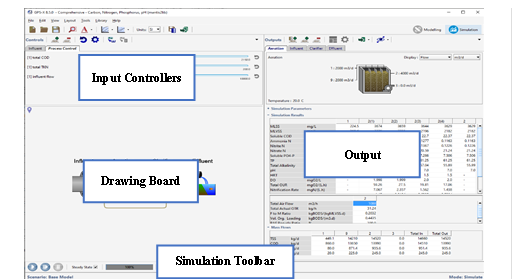
Input Controllers
Here users can create controllers for specific plant properties. For example, shown above are controllers for the influent total carbonaceous BOD, total TKN and influent flow, as well as some process control variables. These allows users to have quick access to variables to be adjusted during a model simulation.
Drawing Board
This space contains a copy of the plant model. Here users can access all of the same menus that are available in Modelling Mode.
Output
This area contains the output graphic displays. Automatically tabs are created for each model object, and users have the opportunity to develop their own custom tables and graphs to display key characteristics of interest.
Once a simulation is run, users have access to buttons to export results, display mass and flow rates on the plant schematic (Sankey and Mass Balance Diagrams), and observe the Energy Usage Summary and Operating Cost Summary information.
Simulation Toolbar
Here users can run the plant simulations. There are Play, Continue, and Pause buttons, and the bar allows for users to see the extent of convergence when the simulation is running. Additionally, within this toolbar, users can create customized scenarios that allow for adjustment of specific model properties.
The subsequent tutorials contained within this manual will provide an in-depth exploration of the GPS-X interface and features available in this software. Tutorials 1 – 8 should be completed if you are new to using GPS-X, while the remaining tutorials cover specific topics that may not be applicable for every user.